

Nigerian Founders Raised $113.7M in June — What’s Actually Driving It
Nigerian startups reportedly raised $113.7 million in June 2026, occurring against a backdrop the same reporting describes as 1,476 active startups and four unicorns in the Nigerian ecosystem (Mean.ceo, 2026a).
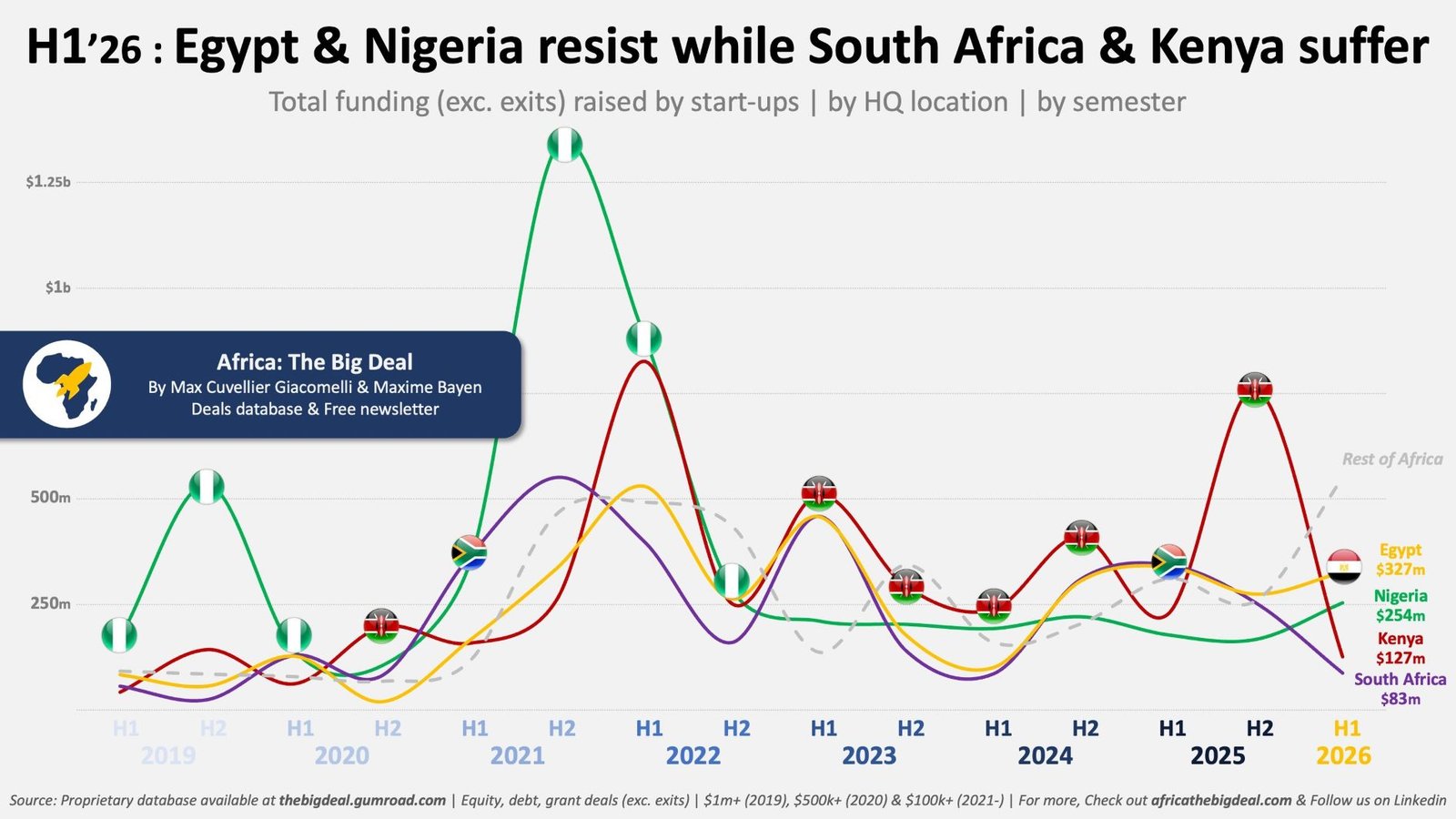
This figure should be read alongside more rigorously sourced half-year data: Africa: The Big Deal’s H1 2026 dataset shows Nigeria’s pure equity funding at $214 million for the first six months of the year, actually outpacing Egypt’s $183 million in equity funding despite Egypt’s larger headline total (driven substantially by a single mega-round in EV and battery-swapping) (Tech In Africa, 2026). Including debt financing, Nigeria’s H1 total reached $254 million, placing it second continentally behind Egypt’s $327 million but ahead of Kenya ($126 million) and South Africa ($83 million) (Tech In Africa, 2026).
The sectoral concentration is consistent across sourcing: fintech, logistics, healthtech, energy, and AI tools are repeatedly identified as the strongest-performing categories for Nigerian startups in 2026 (Mean.ceo, 2026a; Liners, 2026). Separate ecosystem data places Nigeria’s 2026 year-to-date funding at $737 million with fintech products (462) substantially outnumbering the next-largest category, crypto and Web3 (107) (Liners, 2026) — though this figure’s methodology and date range were not fully specified in the source reviewed, and should be treated as directional rather than precise.
Nigeria’s H1 2026 equity performance represents its strongest half-year showing since 2022, when the market last crossed the $250 million threshold in a six-month window, following what analysts describe as an intervening “funding winter” that saw continent-wide venture capital fall from a 2022 peak of roughly $6.5 billion to approximately $2.8 billion by 2024 (MOHAC Africa, 2026; Tech In Africa, 2026).
Consultancies advising investors or founders on the Nigerian ecosystem should treat the H1 2026 recovery as a genuine but still-partial rebound relative to 2022 peak levels, not a full-cycle recovery. Given policy support such as the Nigeria Startup Act, the more decisive factor for continued momentum, per sector commentary, is whether individual startups can convert funding into repeatable sales and retention rather than funding availability alone (Mean.ceo, 2026a).
References
Liners. (2026). Nigeria tech ecosystem 2026: Startups, funding, unicorns & investors. https://liners.com/african-tech-ecosystem/nigeria
Mean.ceo. (2026a, August). Startups in Nigeria news, August 2026. https://blog.mean.ceo/startups-nigeria-news-august-2026/
MOHAC Africa. (2026, June 6). Startup funding opportunities for Africans between 2025–2026. https://mohacafrica.org/startup-funding-opportunities-for-africans/
Tech In Africa. (2026, July). Egypt tops Africa’s H1 2026 startup funding, but Nigeria reclaims the equity crown. https://www.techinafrica.com/egypt-tops-africas-h1-2026-startup-funding-but-nigeria-reclaims-the-equity-crown/